Post Bridge Hit $35K MRR. The API Wedge Matters.
Post Bridge reached $35K USD MRR as a solo-founder social scheduling tool. The case is strongest as a teardown of low-complexity pricing, founder-led distribution, and the API/MCP wedge, with customer count, churn, ARR, and tier mix explicitly left undisclosed.

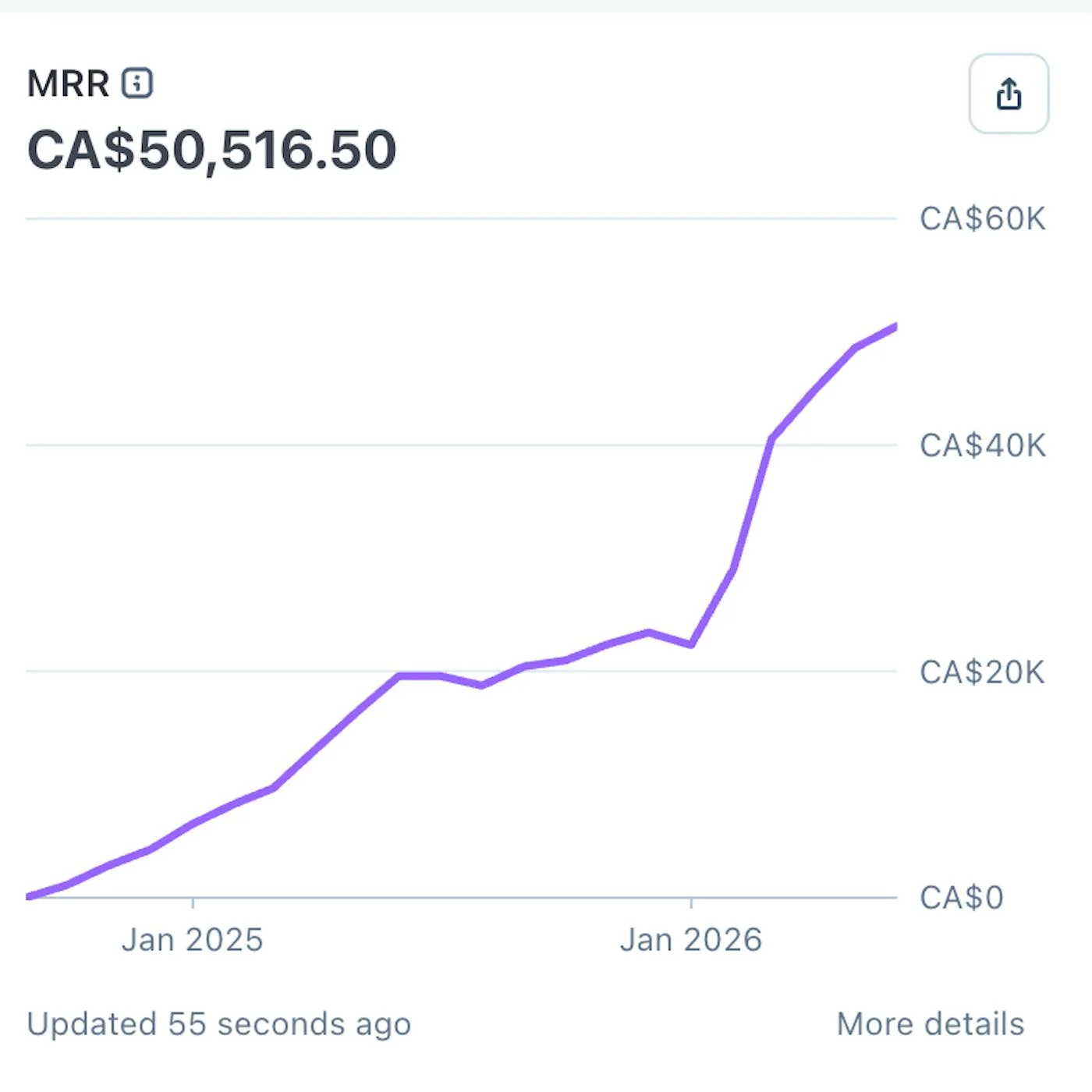
Post Bridge is the cleanest qualifying case this week because the core number is public and recent: Jack Friks said the solo-founder social scheduling tool reached $35,000 USD MRR on June 17, 2026, equal to about CA$50,516.50, after doubling MRR over the previous six months and sitting through roughly an eight-month plateau. 1 The public record supports a real mechanism, but it does not support a full funnel clone. Paying customer count, churn, MRR by tier, and post-June-17 revenue movement are undisclosed.
The useful read is narrower. Post Bridge wins by being a cheaper, simpler cross-posting tool for creators and small teams, then adds a developer/API layer most lightweight schedulers do not emphasize.
Snapshot box
| Field | Public status |
|---|---|
| Product | Post Bridge, a social media scheduling, cross-posting, and content management tool. 2 |
| Founder | Jack Friks, the public solo founder behind Post Bridge. 1 |
| MRR | $35,000 USD MRR disclosed on June 17, 2026; Jack also gave the Canadian-dollar equivalent as about CA$50,516.50. 1 |
| Team size | Solo founder, based on the founder disclosure in the research package. 1 |
| First public prototype | Jack shared the prototype on X on September 23, 2024, writing, "been working on this tool for myself, almost done!" 3 |
| Launch timing | Jack said he launched the product about one month after the prototype post. 1 |
| Pricing | Creator at $29/month, Growth at $49/month, Pro at $99/month, plus a Developer API add-on at $5/month or $50/year for active subscribers. 2 |
| Customer count | Undisclosed. The research package notes a 1,405-users figure, but the public materials do not confirm whether that means paying customers or total users. |
| Churn / retention | Undisclosed. |
| ARR | Not independently disclosed; the public figure is MRR. 1 |
The snapshot gives enough to study the business, but not enough to spreadsheet-copy it. A $35K MRR social scheduler with no public churn, customer count, or tier mix should be treated as a mechanism case, not a valuation case.
Origin: the pain was distribution, not scheduling as an abstraction
Post Bridge began with Jack trying to promote his mobile app Curiosity Quench. He had to make short videos every day, then post them across multiple social platforms by hand. That workflow was slow and did not scale, so he started building an API-based scheduling tool for himself. 1
That matters because the origin was not "social media managers need a dashboard." The first job was more specific: one founder wanted to publish the same short-form content across several platforms without burning the day on manual uploads. Jack's prototype post was plain about the starting point: "been working on this tool for myself, almost done!" 3
The market signal came before the polished product. Jack said he shared the tool on Twitter and that, despite having few followers, the post blew up because other people wanted it too. 1 The original prototype post showed a rough upload flow and platform buttons for Twitter/X, YouTube, TikTok, and Instagram, and the screenshot in the research package captured 459K views on that post. 3
The origin story has one useful constraint for readers: Jack was already using content distribution as an operating system. A founder who only wants to build a scheduler because schedulers have revenue screenshots is missing the point.
Wedge: simple cross-posting at a much lower price, plus an API lane
Post Bridge's front-door wedge is price and scope. The site positions the product as having the "same core features" at "1/10th the price," with support for X/Twitter, Instagram, LinkedIn, Facebook, TikTok, YouTube, Bluesky, Threads, Pinterest, and Google Business. 2 That is a direct attack on the buyer who does not need the enterprise weight of Buffer or Hootsuite but still needs broad platform coverage.
The feature set is deliberately practical: cross-posting, scheduling, content management, Content Studio, bulk video scheduling, carousel support, analytics in beta, and human support. 2 Product Hunt also describes Post Bridge as a tool for scheduling posts across multiple social media platforms. 4 None of that is exotic. That is why the price point matters. The wedge is not a magical feature; it is enough capability with less operational drag.
The second wedge is more interesting. Post Bridge sells a Developer API add-on for $5/month or $50/year, available to active subscribers, and the site says users can connect it to AI tools through MCP, the Model Context Protocol used to let AI assistants operate external tools through a standard interface. 2 The product also mentions OpenClaw agent support. 2
That API layer changes the comparison set. A plain scheduler competes on calendar UI, supported platforms, and price. A scheduler with API and MCP support can become publishing infrastructure for a developer, agency, or AI-heavy creator workflow. A reader should not overstate this as a moat; the source does not disclose API attach rate or revenue by add-on. But the wedge is specific enough to analyze. Post Bridge is cheap enough for creators, yet programmable enough for builders who want social posting inside their own systems.
The public usage claim is also large: the Post Bridge site says the tool has processed more than 2 million posts. 2 That number does not equal paying customers.
Pricing teardown: three paid tiers, no free plan, small API upsell
Post Bridge uses a paid-only structure with a free trial and no freemium plan. 2 The public pricing has three main tiers: Creator at $29/month, Growth at $49/month, and Pro at $99/month. 2 The Developer API add-on costs $5/month or $50/year and requires an active subscription. 2
| Tier | Price | Publicly stated limit / upgrade logic |
|---|---|---|
| Creator | $29/month | 15 social accounts, unlimited posts, scheduling, carousel support, bulk video scheduling, Content Studio access, analytics beta, API add-on availability, and human support. 2 |
| Growth | $49/month | 50 social accounts, everything in Creator, viral growth consulting, priority human support, and invited team members. 2 |
| Pro | $99/month | Unlimited social accounts and everything in Growth. 2 |
| Developer API add-on | $5/month or $50/year | Programmatic access for active subscribers. 2 |
The tiering is clean because the expansion axis is obvious: number of social accounts, support priority, team access, and unlimited-account needs. The Creator tier is not a crippled teaser. It includes unlimited posts and enough account slots for a solo creator or small operator. Growth adds a team and consulting angle. Pro removes the social-account ceiling.
The price evolution is part of the story. Marketer Gems reported earlier pricing around July 2025 at Starter $9, Creator $18, and Pro $27. 5 The current public pricing is materially higher, with the lowest paid tier at $29/month. 2
The freemium choice is the most important pricing decision. Post Bridge offers a free trial but no free plan. 2 That matches Jack's advice in the Indie Hackers interview: "Charge for your product. Don't fear low sales." 1
Acquisition channel: founder-led content, self-use, and proof through repetition
Post Bridge's acquisition story starts with X/Twitter. Jack's first public prototype post on September 23, 2024 became a demand test, and Jack later said the post blew up even though he did not have many followers at the time. 3 1 Since then, the growth motion has been public: feature updates, revenue milestones, and founder commentary around the business.
The stronger acquisition loop is that Jack used Post Bridge to distribute his own products. The research package says Jack used Post Bridge daily to promote Curiosity Quench, producing more than 100K downloads and more than 100M views for that app. 1 That is the kind of proof a scheduler needs. The product is credible because the founder's own distribution problem was visible.
Jack also described a TikTok template strategy: create one video format, reuse it more than 300 times, and change only some elements until views declined. 1 The same source says that strategy drove more than 30K downloads for one mobile app. 1 This is not a vague "post consistently" lesson. It is a production system: find a format, repeat it, vary the inputs, and stop when the format decays.
The Bootstrapped Founder transcript adds the qualitative layer. Jack argued that human content can connect better than AI-generated content or ads, and he said, "if you're honest, if you're being yourself, if you're being a human, it's gonna stand out." 6 That quote should not be softened into motivational advice. In this business, it is channel strategy. The founder sells a product for distributing human-made content, then acquires attention by showing the human operator behind it.
There is also a YouTube layer, but the available evidence is thinner. The research package notes about a year of YouTube dev logs and Instagram cross-posting. 6
Replication checklist
A reader trying to copy Post Bridge should copy the conditions, not the category.
- Start with a repeated distribution chore you already perform. Jack built the tool after manually posting short videos across platforms while promoting Curiosity Quench. 1 If a founder does not personally feel the workflow, the first version will likely be a generic dashboard.
- Serve a buyer who wants cheaper simplicity, not enterprise completeness. Post Bridge explicitly positions itself as the same core features at one-tenth the price, and its main tiers run from $29/month to $99/month. 2 That positioning works only if the buyer values enough functionality more than procurement-grade depth.
- Pick an expansion axis customers understand. Post Bridge expands by social account count, support, team members, and unlimited-account usage. 2 A clone needs a similarly obvious reason to move up-tier.
- Build a public proof loop. Jack used the product to distribute his own apps, and the research package attributes more than 100K downloads and more than 100M views for Curiosity Quench to that operating loop. 1 The best proof for a tool like this is not a feature checklist; it is the founder using it under pressure.
- Add a developer lane only if the core product already works. Post Bridge's Developer API add-on and MCP support make the product more useful for programmable workflows. 2 That layer would be a distraction if the basic cross-posting job were weak.
- Charge early enough to test willingness to pay. Jack's public advice was direct: "Charge for your product. Don't fear low sales." 1 A free-plan audience would not have tested the same thing.
Honest assessment: what is not replicable
The first non-replicable advantage is founder-channel fit. Jack did not merely build a social scheduler and then look for distribution. He was already making short videos, posting across platforms, and using content to grow mobile apps. 1 A cold-start founder who does not create content at high volume cannot copy that credibility in a weekend.
The second advantage is visible proof from another product. Curiosity Quench gave Jack a live use case for Post Bridge, and the research package says that loop produced more than 100K downloads and more than 100M views. 1 Many B2B tools struggle because the founder cannot demonstrate the tool inside a real business. Jack could.
The third advantage is persistence through a long pre-win period. The Indie Hackers headline frames the $35K MRR milestone after four years of trying to make money online, and Jack said the product had an eight-month plateau before the recent six-month MRR doubling. 1 That time is not a tactic. It is accumulated taste, distribution reps, and tolerance for slow feedback.
The fourth advantage may be cost discipline. Jack said, "It cost me nothing except time to build. Now that I have users, costs are between $100 and $200 per month." 1 If accurate at the time of the interview, that is a powerful indie setup. But it depends on the founder being able to build, maintain, and support the product without a large team.
The public story is strong, but it is not a clean cold-start recipe.
Three lessons that generalize
1. The best wedge may be "less product" if the incumbent category is bloated. Post Bridge does not need to out-enterprise Hootsuite. Its public claim is same core features at one-tenth the price, with broad platform support and lower complexity. 2 That is a valid wedge when the buyer is a creator, small team, or developer rather than a corporate social department.
2. Pricing should expose the expansion logic. Post Bridge's account-count ladder is easy to understand: 15 accounts at $29/month, 50 accounts at $49/month, and unlimited accounts at $99/month. 2 A buyer can see when the next tier becomes relevant without a sales call.
3. Build-in-public works best when the product itself helps the founder produce public proof. Jack's content loop was not detached from Post Bridge. He used the tool to promote his own app, and that use case generated the origin story, the proof, and part of the acquisition channel. 1 That is much stronger than posting founder updates about a product the founder barely uses.
Sources table
| # | Source | What it supports |
|---|---|---|
| 1 | Indie Hackers: Hitting $35K MRR After Struggling to Make Money Online for Four Years | $35K MRR disclosure, June 17 date, origin story, cost quote, pricing advice quote, plateau and doubling context, Curiosity Quench distribution claims. |
| 2 | Post Bridge website | Current pricing, platform support, product features, API add-on, MCP support, free trial / no free plan, processed-posts claim. |
| 3 | Jack Friks original prototype post on X | September 23, 2024 prototype post, self-use quote, early public demand signal. |
| 4 | Product Hunt: Post Bridge | Product positioning as a multi-platform social scheduling tool. |
| 5 | Marketer Gems: Jack Friks' PostBridge story | Earlier pricing context around Starter $9, Creator $18, and Pro $27. |
| 6 | The Bootstrapped Founder transcript: Jack Friks | Founder comments on human content, channel thinking, dev-log context, and product philosophy. |
Cover image: revenue chart from the research package showing Post Bridge at CA$50,516.50 MRR.
Related content
- Sign in to comment.